5:46 pm, Monday, 30 March 2026

Worries over US market, advice to proceed strategically

  • The Time
  • Update Time : 02:53:06 pm, Wednesday, 25 February 2026
  • 48
Monzu-Info-Tech
Monzu-Info-Tech

Accenture Footwear & Leather Products, a Savar-based company in Dhaka, exports leather bags, with the majority of its products destined for the United States. After reciprocal tariffs were imposed last year, the company secured orders from a new US buyer. As a result, by the end of last year its exports rose by 18 per cent compared to the previous year.

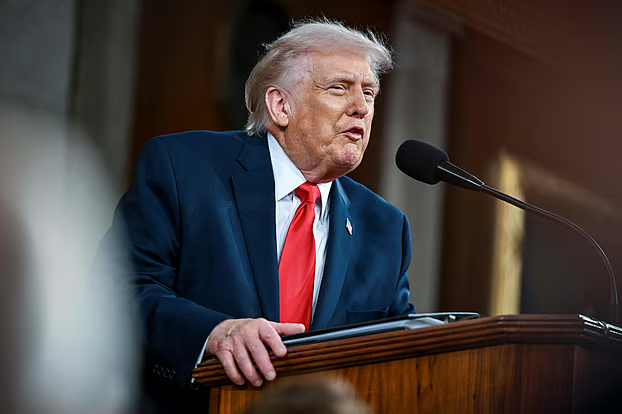
The reciprocal tariffs imposed by US President Donald Trump were declared illegal last Friday by the Supreme Court of the United States. Shortly afterward, Trump imposed a fresh 15 per cent tariff on goods from all countries under a different law. In this context, AKM Moshfiqur Rahman, managing director of Accenture Footwear & Leather Products, is somewhat concerned about exports to the US market.

Speaking to Prothom Alo yesterday, Moshfiqur Rahman said, “After Trump’s reciprocal tariffs came into effect last year, Bangladesh was in a somewhat advantageous position. We secured a new US buyer at that time. We are currently in talks with another buyer. We are quite optimistic about this market. However, the renewed tariff complications have created uncertainty again.” He added that if tariff rates remain the same for all competing countries, it may not pose a major problem.

In addition to Moshfiqur Rahman, several other exporters spoke to Prothom Alo on Sunday. They said that the renewed volatility over tariffs is certainly a cause for concern. With the reciprocal tariffs declared illegal, equal opportunities may emerge for competing countries, increasing competition. 

Nevertheless, Bangladesh will still have opportunities. To ensure the country does not fall behind others in the current situation, the new government must remain cautious. They also believe that the government should review the trade agreement with the United States. Experts, meanwhile, have advised proceeding strategically.

On 2 April last year, Donald Trump imposed reciprocal tariffs at varying rates on products from 157 countries. Although these were scheduled to take effect on 9 April, they were suspended for three months. 

The United States then began bilateral discussions with various countries. Initially, tariffs on Bangladeshi goods were set at 37 per cent, later reduced to 35 per cent on 8 July. After Bangladesh pledged to increase imports of US goods at both government and private levels, it reached an understanding with the Trump administration, reducing the reciprocal tariff to 20 per cent. The measure took effect on 7 August.

Following the imposition of reciprocal tariffs, Bangladesh signed a reciprocal trade agreement with the United States on 9 February. Under the deal, the reciprocal tariff rate on Bangladesh was reduced to 19 per cent. Within two weeks, however, the US Supreme Court declared the reciprocal tariffs imposed on Bangladesh and several other countries illegal.
Tag :

Write Your Comment

About Author Information

The Time

Popular Post

Worries over US market, advice to proceed strategically

Update Time : 02:53:06 pm, Wednesday, 25 February 2026

Accenture Footwear & Leather Products, a Savar-based company in Dhaka, exports leather bags, with the majority of its products destined for the United States. After reciprocal tariffs were imposed last year, the company secured orders from a new US buyer. As a result, by the end of last year its exports rose by 18 per cent compared to the previous year.

The reciprocal tariffs imposed by US President Donald Trump were declared illegal last Friday by the Supreme Court of the United States. Shortly afterward, Trump imposed a fresh 15 per cent tariff on goods from all countries under a different law. In this context, AKM Moshfiqur Rahman, managing director of Accenture Footwear & Leather Products, is somewhat concerned about exports to the US market.

Speaking to Prothom Alo yesterday, Moshfiqur Rahman said, “After Trump’s reciprocal tariffs came into effect last year, Bangladesh was in a somewhat advantageous position. We secured a new US buyer at that time. We are currently in talks with another buyer. We are quite optimistic about this market. However, the renewed tariff complications have created uncertainty again.” He added that if tariff rates remain the same for all competing countries, it may not pose a major problem.

In addition to Moshfiqur Rahman, several other exporters spoke to Prothom Alo on Sunday. They said that the renewed volatility over tariffs is certainly a cause for concern. With the reciprocal tariffs declared illegal, equal opportunities may emerge for competing countries, increasing competition. 

Nevertheless, Bangladesh will still have opportunities. To ensure the country does not fall behind others in the current situation, the new government must remain cautious. They also believe that the government should review the trade agreement with the United States. Experts, meanwhile, have advised proceeding strategically.

On 2 April last year, Donald Trump imposed reciprocal tariffs at varying rates on products from 157 countries. Although these were scheduled to take effect on 9 April, they were suspended for three months. 

The United States then began bilateral discussions with various countries. Initially, tariffs on Bangladeshi goods were set at 37 per cent, later reduced to 35 per cent on 8 July. After Bangladesh pledged to increase imports of US goods at both government and private levels, it reached an understanding with the Trump administration, reducing the reciprocal tariff to 20 per cent. The measure took effect on 7 August.

Following the imposition of reciprocal tariffs, Bangladesh signed a reciprocal trade agreement with the United States on 9 February. Under the deal, the reciprocal tariff rate on Bangladesh was reduced to 19 per cent. Within two weeks, however, the US Supreme Court declared the reciprocal tariffs imposed on Bangladesh and several other countries illegal.